Revolution in the Air by Clinton Heylin
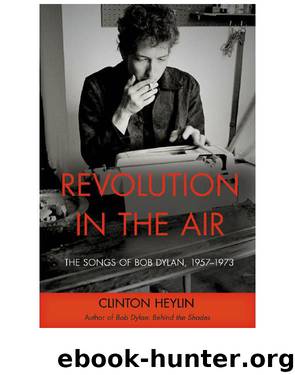
Author:Clinton Heylin [Heylin, Clinton]
Language: eng
Format: epub
Publisher: Chicago Review Press/A Cappella
Published: 2010-11-17T06:00:00+00:00
{148} LIKE A ROLLING STONE
Published lyrics: Writings and Drawings; Lyrics 1985; Lyrics 2004.
Known studio recordings: Studio A, NY, June 15, 1965—5 takes [TBS]; June 16, 1965—15 takes [H61—tk.4].
First known performance: Newport Folk Festival, July 25, 1965 [OSOTM].
I wrote "Rolling Stone" after England. I boiled it down, but it’s all there. . . . I knew I had to sing it with a band. I always sing when I write, even prose, and I heard it like that. —Dylan to Ralph J. Gleason, December 1965
In March 1965, speed-rapping with Paul Jay Robbins, full-time hipster and part-time L.A. journo, Dylan openly admitted he still hadn’t got where he wanted: "I’ve written some songs which are kind of far out, a long continuation of verses, stuff like that—but I haven’t really gotten into writing a completely free song." It was a theme he was now warming to, telling others about these "songs which are . . . a long continuation of verses," without ever demonstrating what he had in mind. One suspects he didn’t know himself. He probably had in mind a song that distilled elements of "A Hard Rain’s A-Gonna Fall," "Mr. Tambourine Man," and "It’s Alright, Ma."
Earlier Beat aspirations now became attached to the tutorial he’d already had in tradition. Making a musical Molotov cocktail of the two, he jettisoned page-bound poetry for good. He now knew one could be a songwriter and a poet utilizing the same medium. As he told Nat Hentoff privately, a matter of months after he cracked the code, he could still "remember . . . writing those [other] things. The other stuff I was doing didn’t even resemble those [earlier songs] at all. They resembled more what I’m writing today, in terms of songs." The schema adopted for Tarantula by the summer of 1964 contained its fair share of song-like rhythms. Refusing to be hidebound by line breaks, Dylan wrote screeds of speed, all amphetamine alliteration, as he demonstrated in a short correspondence with the late Tami Dean:
An god’s own pillars’ve even turned t rust
sugar tastes bitter. Salt is sweet
ramming bali ligosi girls on the tails of mice
rats ring the bells
truth don’t lie in the alley dead
bums don’t die
cleopatra’s sister opens her mouth at the manhole
tries t grab mayor wagner’s son.
Just as John Lennon needed to write two books of offbeat poetry to get to "Nowhere Man" and "In My Life," Dylan’s year-long jag of speed-writing helped him adopt a more intuitive approach to the song form, integrating everything around the malleable framework of a tune and arrangement. As he told Nat Hentoff the second time around, "‘Like a Rolling Stone’ changed it all; I didn’t care any more after that about writing books or poems or whatever. [Here] was something that I myself could dig. . . . My songs are pictures and the band makes the sound of the pictures."
Dylan did not arrive at this defining song easily. Shortly after completing the Highway 61 set
Download
This site does not store any files on its server. We only index and link to content provided by other sites. Please contact the content providers to delete copyright contents if any and email us, we'll remove relevant links or contents immediately.
The Goal (Off-Campus #4) by Elle Kennedy(13780)
Kathy Andrews Collection by Kathy Andrews(11973)
Diary of a Player by Brad Paisley(7648)
Assassin’s Fate by Robin Hobb(6297)
What Does This Button Do? by Bruce Dickinson(6262)
Big Little Lies by Liane Moriarty(5877)
Altered Sensations by David Pantalony(5155)
Pale Blue Dot by Carl Sagan(5081)
Sticky Fingers by Joe Hagan(4255)
The Death of the Heart by Elizabeth Bowen(3676)
The Heroin Diaries by Nikki Sixx(3609)
Confessions of a Video Vixen by Karrine Steffans(3351)
Beneath These Shadows by Meghan March(3341)
How Music Works by David Byrne(3328)
Computational Linguistics and Intelligent Text Processing: 20th International Conference, CICLing 2019 La Rochelle, France, April 7â13, 2019 Revised Selected Papers, Part I by Alexander Gelbukh(3245)
The Help by Kathryn Stockett(3189)
Jam by Jam (epub)(3156)
Harry Potter 4 - Harry Potter and The Goblet of Fire by J.K.Rowling(3132)
Strange Fascination: David Bowie: The Definitive Story by David Buckley(2911)
